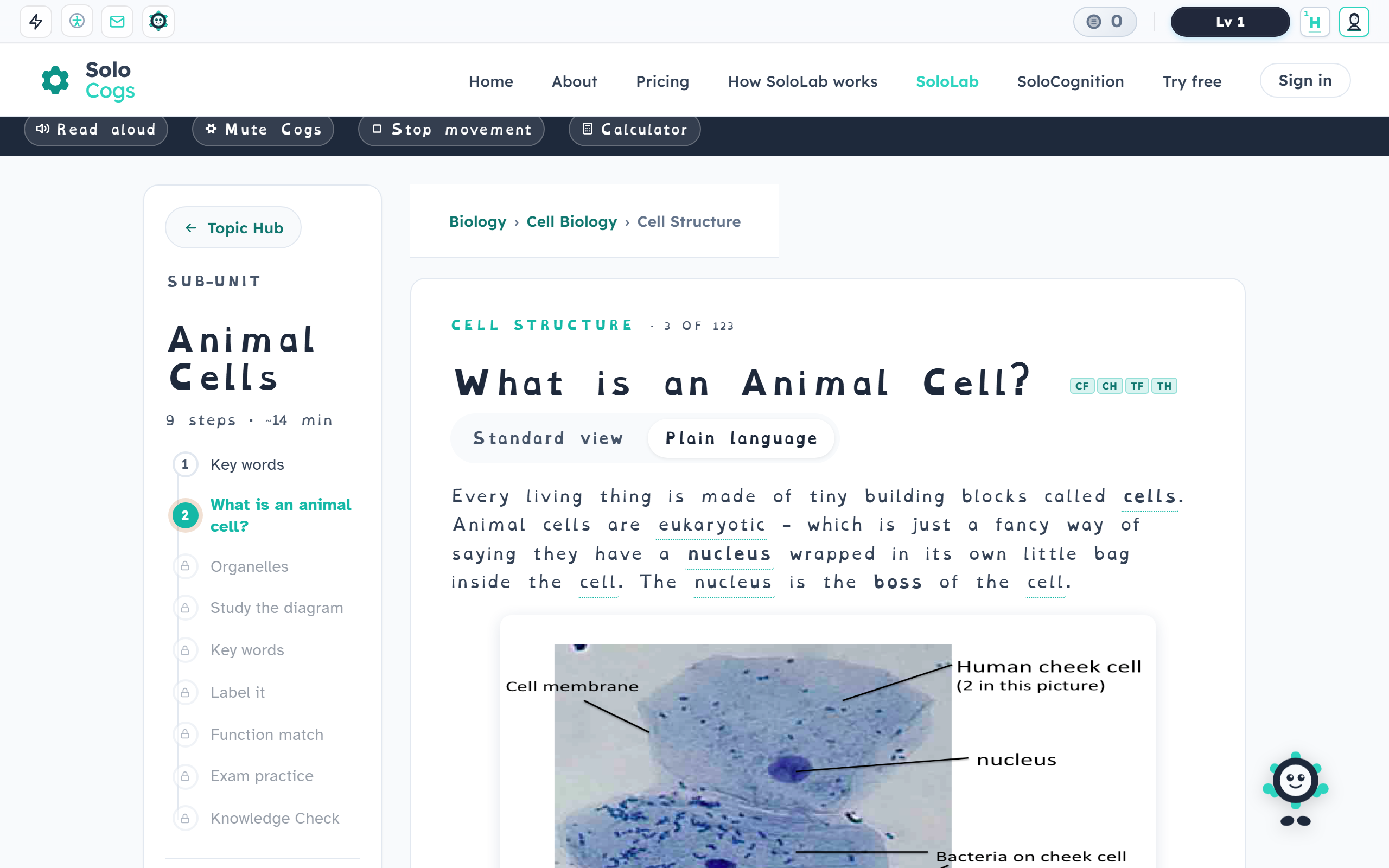
Accessible by default
Every tool built in, none forced.
Read-aloud, dyslexia font, plain-English mode, colour overlays, dark mode - a student picks what helps.
Every learner is different - some need extra support, some extra challenge, some accommodations - and SoloCogs is built to give all three, not bolt them on. A full teacher-built platform for Foundation and Higher Tier, KS3 and GCSE - built for the digital-first direction of the 2027 AQA refresh.
Built by a qualified science teacher, after years of watching students hit the same gaps in class - and building the lessons that fill them.
Nothing to pay until 1 November · Join before 30 September · From £14.99/month afterNo account needed - open a real SoloLab lesson or a full SoloCognition quiz in your browser right now.
Every screen below is the actual platform - not a mockup, not a stock photo. Hover on any card to lift it.
Read-aloud, dyslexia font, plain-English mode, colour overlays, dark mode - a student picks what helps.
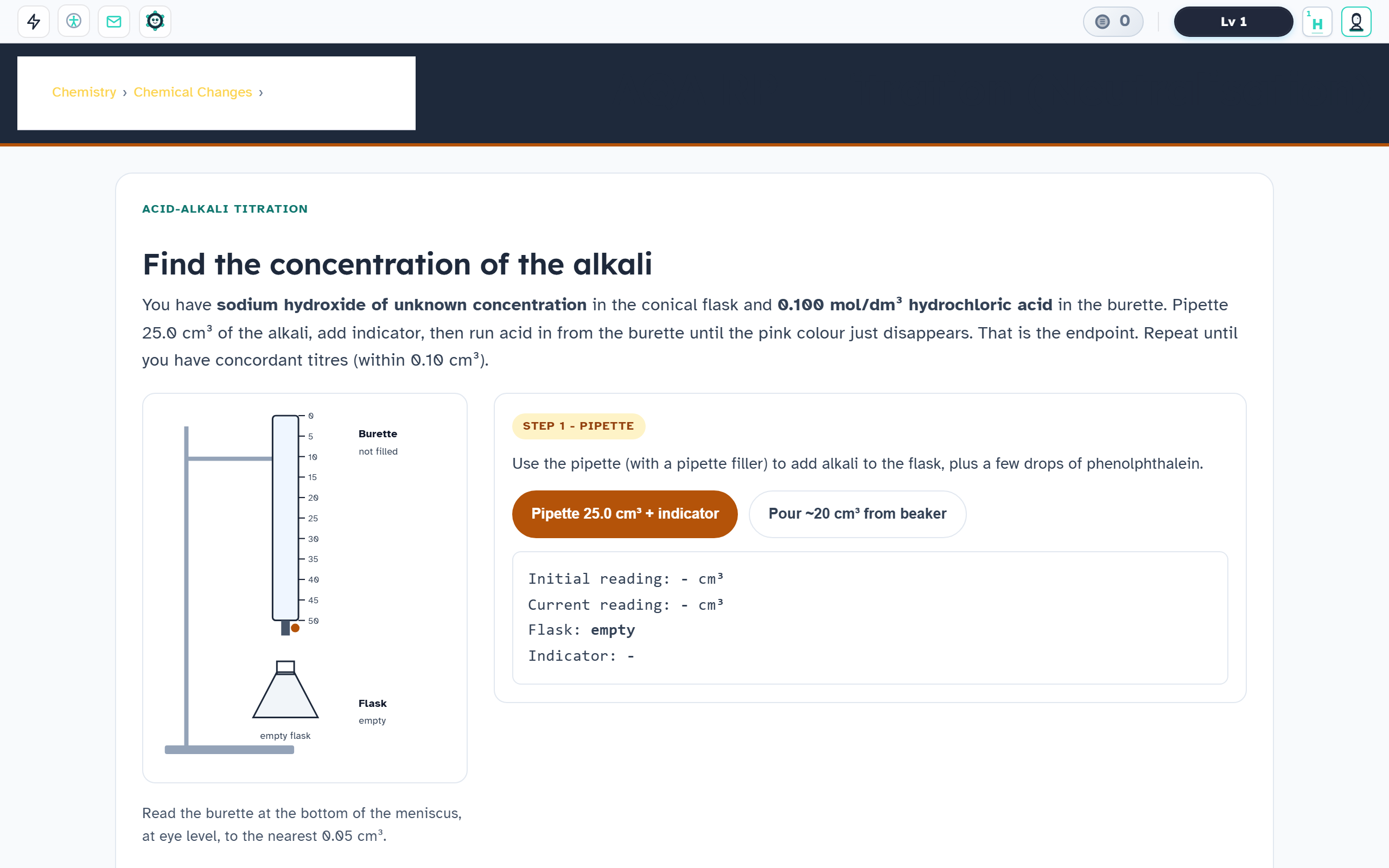
Real equipment behaviour. Every attempt produces exam-board evidence for the AT (Apparatus and Techniques) skills.
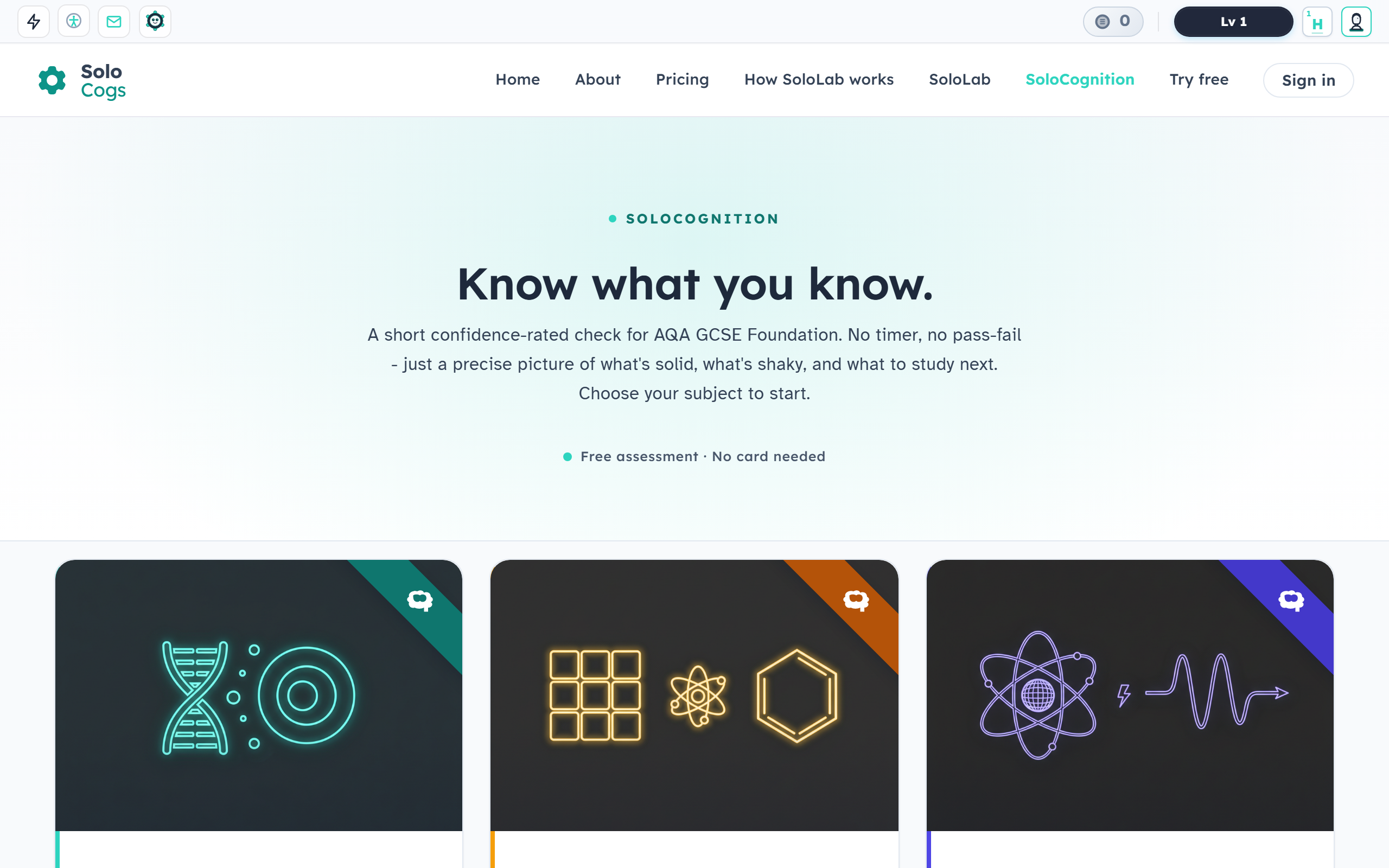
A secure answer and a lucky guess never look the same. Four Knowledge Flags sort every response, automatically.
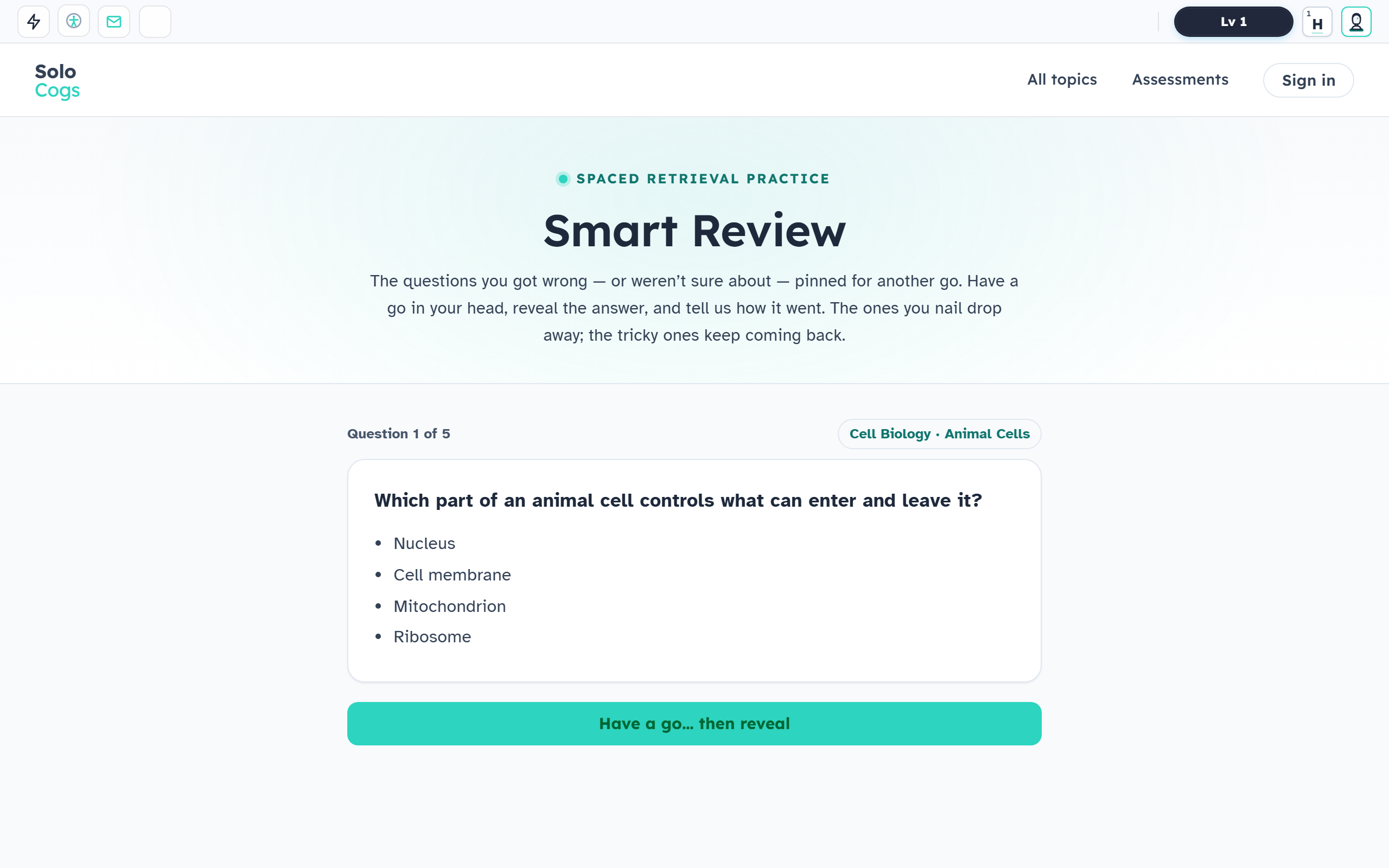
Subtopic-level Knowledge Map after every session. Focus-area recommendations, not "just keep revising".
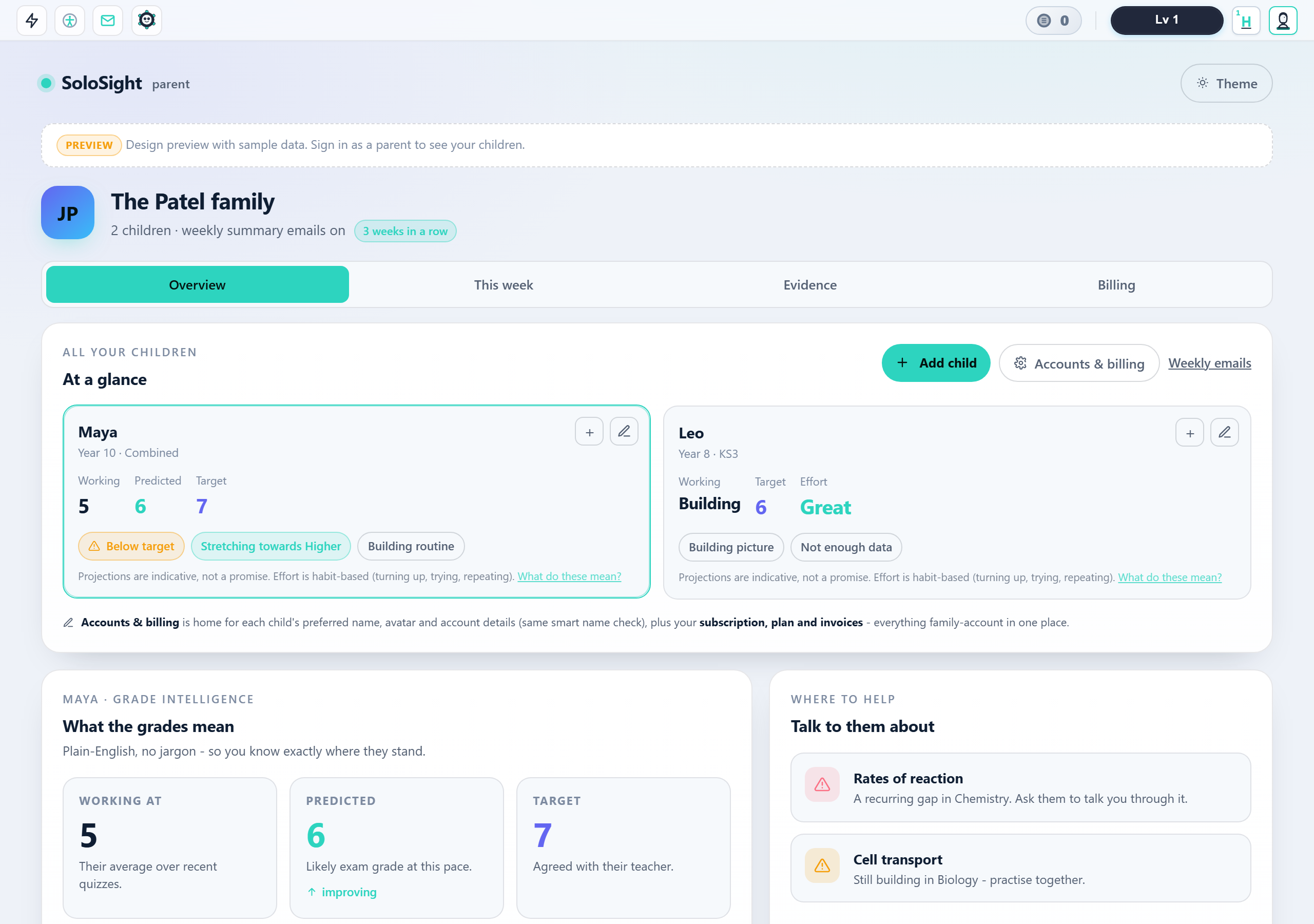
Parent, tutor, teacher, and school admin all see the SAME picture the student sees on their own screen.
Quick Fire, Spot the Lie, Hex Path, The Hot Seat, Reveal Round, Right on Target - the same content, six ways to practise it.
A standard quiz tells you what a student got wrong. SoloCognition tells you why - and picks a different next step for each of the four Knowledge Flags. Try it here.
Cell Biology · Animal CellsWhich structure in an animal cell controls what enters and leaves it?
No timer, no pass-fail - just an honest read.
Seneca and Sparx are excellent at what they do - both are on our recommend list for what they cover well. But these seven things nobody else in GCSE Science does natively.
| Feature | SoloCogs | Seneca | Sparx |
|---|---|---|---|
| Dyslexia-friendly font, on with one tapAtkinson Hyperlegible - designed so b/d and i/l stay distinct. | ✓ | ✗ | ✗ |
| Plain-English mode alongside AQA wordingSame question, everyday words - toggled per section. | ✓ | ✗ | ✗ |
| SoloSpell™ - marks the science, not the spelling"fotosynthisis" still gets the mark for photosynthesis. | ✓ | ✗ | ✗ |
| Confidence-rated answers → Knowledge FlagsSorts every answer as Secure, Misconception, Gap or Hesitancy. | ✓ | ✗ | ✗ |
| Every AQA Required Practical as a virtual labInteractive rigs; AT-skill evidence saved automatically. | ✓ | Video | ✗ |
| Every question written by a qualified science teacherNot community-crowdsourced, not AI-first. | ✓ | Mixed | ✓ |
| Free full unit, no card, no loginCell Biology, top to bottom, open to anyone. | ✓ | Login | ✗ |
Fair play. Seneca covers more subjects than we do. Sparx has strong curriculum-linked homework for schools. SoloCogs is built specifically for AQA GCSE Foundation Science, with accommodations built into every screen - because that's what a SEND-focused, teacher-led offer needs to look like.
SoloCogs is designed for three groups. Tell us which one you are and we’ll send updates that actually matter to you.
Looking for GCSE Science support for your child - at school, home, or somewhere in between. Founding rate from £14.99/month, held for each student signed up now.
Jump to the parent form →Assessing SoloCogs for a class, department, or tutoring practice. Free half-term pilot on request. Per-pupil pricing and MAT volume discounts.
Jump to the school form →Think SoloCogs might be for you? Here’s how to ask a grown-up to check it out - a one-tap message they can read in 20 seconds.
Jump to the student panel →SoloLab, SoloCognition, and SoloSight work together - so the student, the parent, the tutor, and the school are all reading from the same page. Every plan includes all three.
Every lesson, every AQA Required Practical, every revision activity across KS3 and GCSE. Foundation and Higher Tier sit side by side so a student can stretch or scaffold as they go.
Short, confidence-rated assessments that separate real understanding from a lucky guess. Every question asks how sure the student feels before it takes an answer - that pair of signals is what makes the picture precise.
Mirror dashboards for the adults. The parent view, the tutor view, the teacher view, and the school admin view all show what the student sees on their own screen - so nobody's reading a different story.
In any class of thirty, some students are dyslexic, some are autistic, some have ADHD, some speak English as an additional language, some have visual stress, and some are just having a hard day. SoloCogs doesn't bolt accommodations on for a few - it builds them in for everyone, then lets each student pick what helps. Nothing is forced, and nothing labels anyone.
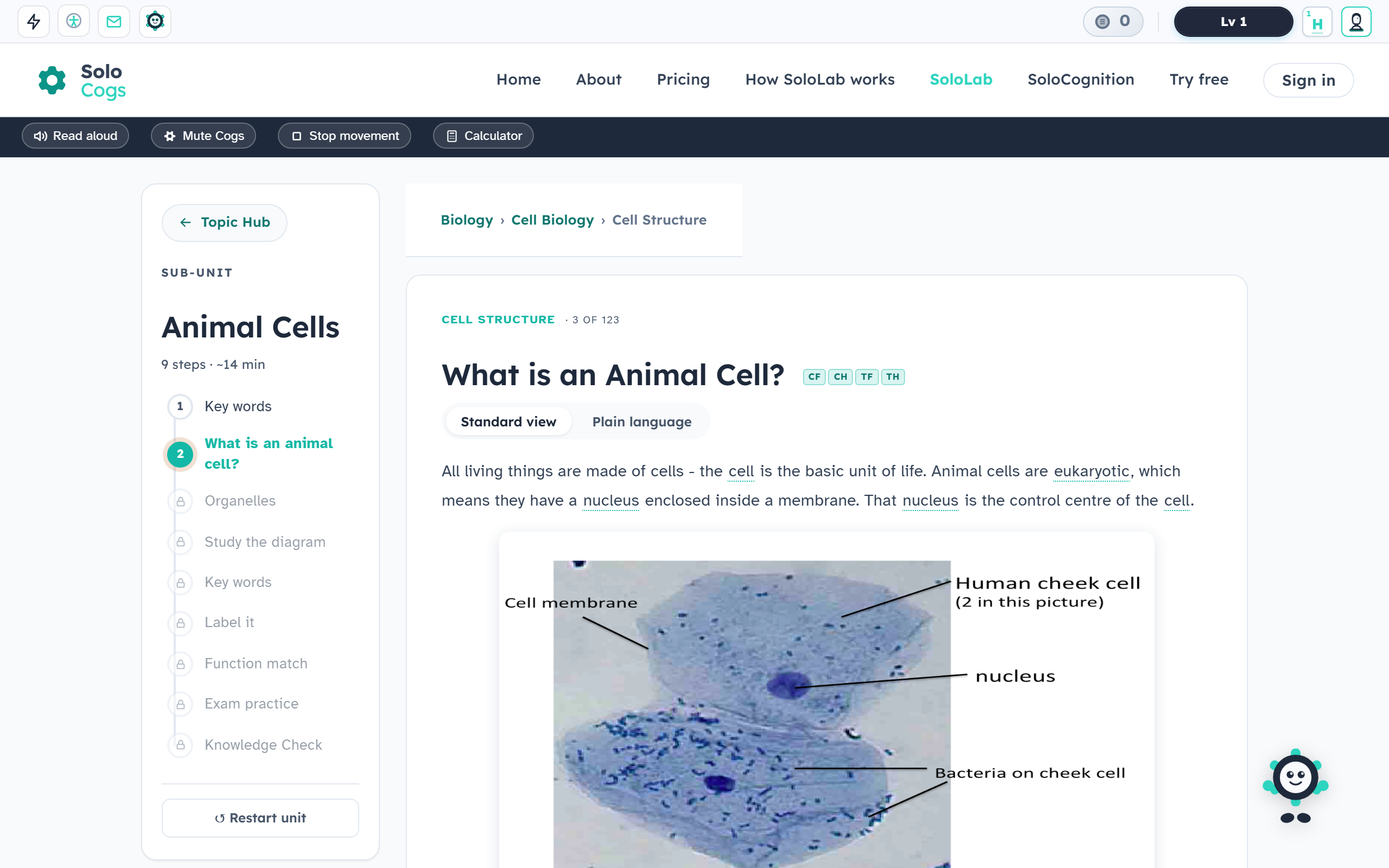
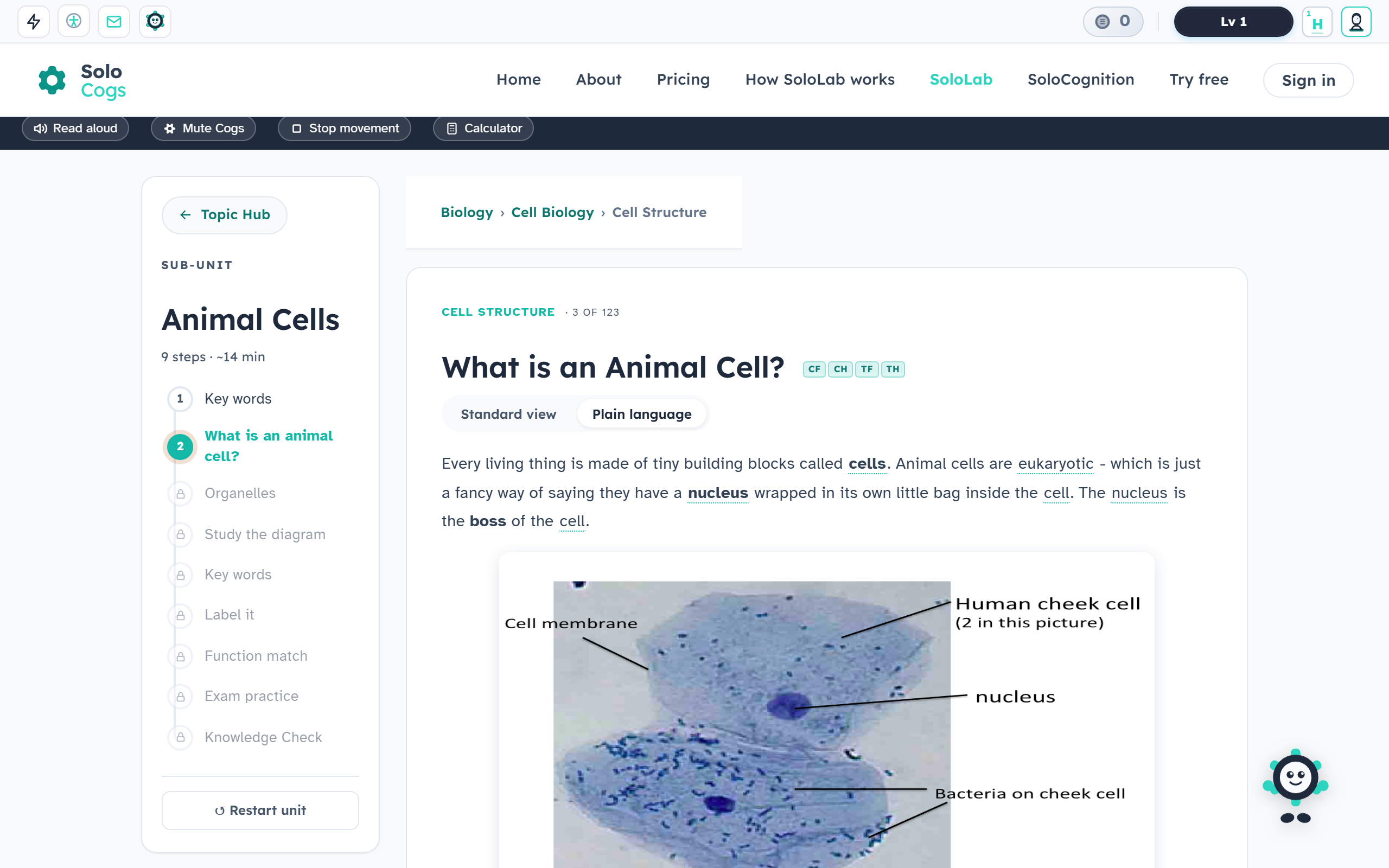
Tap either image to enlarge and read the wording.
Every lesson and question can be read aloud, with the words highlighted as they're spoken.
Helps: dyslexia · EAL · low reading fluency · auditory learnersType fotosynthisis and still get the mark for photosynthesis. The science is assessed, not the spelling.
Helps: dyslexia · dysgraphia · EALAtkinson Hyperlegible - a typeface engineered so letters that usually blur (b/d, i/l) stay distinct.
Helps: dyslexia · visual fatigue (everyone)A plain-language version of every lesson sits beside the exam-board wording, toggled section by section.
Helps: EAL · lower reading age · anyone facing jargonTint the screen to settle text that swims or glares on plain white.
Helps: visual stress · Irlen-type discomfortDim the screen, quiet the animation, retire the bouncing mascot - a lower-stimulation way to work.
Helps: autism · ADHD · light sensitivity · migraineNo timers, resizable text, and a speed set by the student - not an algorithm.
Helps: slower processing speed · anxiety · focus needsA 60-second reset offered before high-load tasks, so nobody's asked to think while overwhelmed.
Helps: anxiety · emotional regulation · exam nervesAnd every adjustment a student uses is logged quietly in the background - so over months it becomes real evidence of their normal way of working, ready for exam access arrangements and EHCP reviews.
Got an idea for an adjustment we haven't built yet? Send it over →
He pops up when a student's stuck, cheers when they land a tricky one, and stays out of the way the rest of the time. Every student meets him on their first SoloLab lesson - he's a study buddy, not a teacher, not a scorekeeper.
SoloCogs isn't built by a tech firm that hired a consultant - it's built by a qualified, experienced science teacher who has taught GCSE Foundation Science in the classroom. So every lesson, question and design choice starts from one place: "what happens when this doesn't work first time?"
"Science isn't difficult because science is impossible. It's often difficult because the way we present it creates unnecessary barriers. SoloCogs removes those barriers so students can focus on understanding the science."
"I built SoloCogs for the students the system leaves behind - the ones who need it read aloud, who spell it ‘wrong’ but know the science, who freeze on a timer. Accessibility isn't a feature I bolted on; it's the reason I started."
Jazz - a qualified, experienced science teacher
SoloCogs is designed for three groups of people. Tell us which one you are and we'll tailor the update we send when we go live. Founding sign-ups are still open.
A grown-up has to set SoloCogs up. Send this message to whoever needs to see it - your parent, carer, teacher, tutor, form tutor, or Head of Science. Works for all of them.
"Send by email" opens your own email app. SoloCogs never sees who you send this to - your email address and your teacher's or parent's address stay private.
If your question isn't here, email hello@solocogs.co.uk and we'll answer directly.
A UK Science platform for KS3 and GCSE (AQA Combined, Foundation and Higher Tier), built so support, challenge and accessibility are the default - not an add-on.
Three tools work together: SoloLab (lessons + virtual Required Practicals), SoloCognition (confidence-rated assessment), and SoloSight (dashboards that show parents, tutors and schools the same picture). The sections above walk through each.
Free content is a brilliant starting point, and plenty of students use it. But tools like those are places to revise - content and quizzing. SoloCogs does the parts content alone cannot.
It works out what a student actually knows, not just whether they clicked the right letter: every answer is confidence-rated, so a secure understanding and a lucky guess never look the same. It points each student to the exact next step, rebuilds every AQA Required Practical as a virtual lab, and builds accessibility in for every learner by default. Parents, tutors and schools all read the same live picture.
There is an honest, side-by-side comparison further up this page.
SoloCogs goes live for the 26/27 academic year - schools deploying from September 2026, families from around the same time.
Family sign-ups open on Tuesday 1 September 2026.
Take the whole first half term to try it, on us. Join any time before 30 September and there is nothing to pay until 1 November. If it is not right for your family, cancel before then and nothing is taken.
Families: from £14.99 a month. Join before 30 September and you take the whole first half term to try it, on us - there is nothing to pay until 1 November. Full access to every unit, then your subscription starts at the normal rate. Our thank-you to the families joining in the launch window.
Schools, MATs, and Local Authorities: per-pupil pricing on request. Volume discounts for MATs and Local Authorities. Get in touch and we'll build the right shape for you.
KS3 Science (Years 7–9) - ten topics across Biology, Chemistry and Physics, building the foundations for GCSE.
GCSE AQA Combined Science - both Foundation and Higher Tier, every topic and every Required Practical, across all three sciences.
GCSE AQA Separate Sciences (Triple) - Biology, Chemistry and Physics as three separate GCSEs, both tiers. Actively being built now, ready for the 26/27 academic year alongside Combined. Founding families and schools get Triple included at their locked-in price, not as a paid upgrade.
Confused by the choice of Foundation vs Higher, or Combined vs Triple? Read our plain-English guide to the four combinations →
Further exam boards (Edexcel, OCR) sit on the roadmap; waitlist members hear when each lands.
Both - it flexes to the learner. For a home-educated, EOTAS or school-refusal student, SoloCogs works as a complete, self-paced GCSE course: every lesson, every practical, every assessment.
Alongside school, it's a targeted top-up - SoloCognition pinpoints exactly what a student hasn't secured, and SoloLab sends them straight to those lessons. Same platform, different job depending on who's using it. Planning a home-ed year? Grab our free printable scheme of work - the whole KS3→GCSE topic map as a checklist.
Yes. Your child's data is stored and processed in the UK - our database and daily backups sit in London (UK GDPR compliant, ICO-registered). The website itself is delivered through a global content network for speed and resilience, but that only serves the site's code and images: no student data is stored on it or leaves the UK. We do not sell, share, or licence student data, and we do not train third-party AI models on student work.
Row-level security protects every record at the database layer, MFA is available for all staff accounts (and required for admins), and TLS 1.3 encrypts everything in transit. Our full policy suite is at /policies.
SoloCogs is built for 11–16-year-olds, so safeguarding sits inside every design decision, not at the end. Concretely:
Schools receive our full safeguarding-forward pack (KCSIE mapping, DPA, sub-processor register, DSL contact route) with the pilot paperwork on request.
Just a web browser. SoloCogs runs on any modern phone, tablet, laptop or school Chromebook - nothing to install, and progress syncs across every device a student signs in on.
Yes. Join before 30 September and there is nothing to pay until 1 November - full access to every unit, and if you cancel before then you pay nothing at all. Schools can run a free half-term pilot before committing, and tutors can arrange one too. Register your interest and we'll set it up.
SoloCogs is built by a qualified, experienced science teacher who has taught GCSE Science in the classroom and knows exactly where students get stuck. Every lesson, question and design decision starts from "what happens when this doesn't work first time?"